Contents
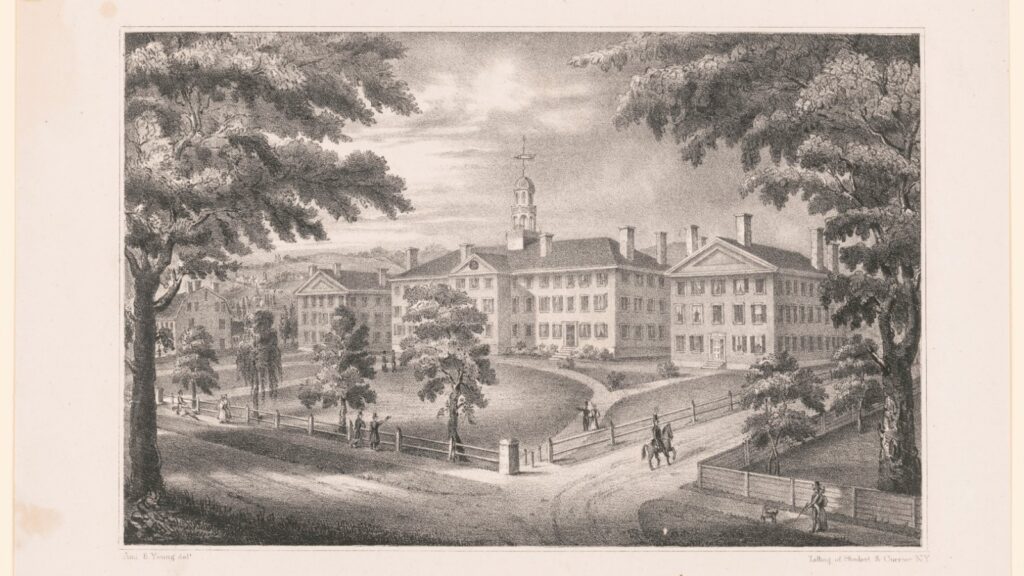
Dartmouth College v. Woodward is the 1819 Supreme Court decision that held a private college’s charter is a contract a state cannot impair. The ruling kept Dartmouth private after New Hampshire tried to turn it into a state-controlled university. Chief Justice John Marshall wrote the opinion of the Court.
Higher Education Resource Hub, higher-ed.org. Last reviewed November 2026. Sources are listed at the end of this page.
Citation and decision
| Full name | Trustees of Dartmouth College v. Woodward |
|---|---|
| Citation | 17 U.S. (4 Wheat.) 518 (1819) |
| Decided | 2 February 1819, February Term 1819 |
| Came from | Superior Court of New Hampshire, on writ of error |
| Opinion of the Court | Chief Justice John Marshall |
| Separate opinions | Justices Bushrod Washington and Joseph Story |
| Dissent | Justice Gabriel Duvall, without a written opinion |
| Result | New Hampshire judgment reversed |
The full report appears in United States Reports, volume 17, at the Library of Congress and on GovInfo. The decision date comes from the reporter text published by Public.Resource.Org.
The case decided the status of one college charter. It did not create a general rule that every college is beyond state regulation.
What did the Supreme Court hold?
The Court held that the 1769 charter was a contract and that the 1816 acts impaired it in violation of the Contract Clause. Article I, Section 10 of the Constitution bars any state from passing a law impairing the obligation of contracts.
- The charter is a contract: Marshall wrote that the charter was “a contract within the letter of the Constitution, and within its spirit also.”
- Dartmouth was private: Because the college was founded and funded by private donors, the Court treated it as an eleemosynary (charitable) and, as to its funds, a private corporation. The state could not reorganize it at will.
- The acts were void: The Court found the 1816 acts put the will of the state in place of the will of the donors in every essential operation of the college.
- What a corporation is: Marshall described a corporation as an artificial being that exists only in contemplation of law, with the rights its charter gives it.
Justice Story added a limit in his separate opinion. A legislature that wants power to alter a charter, he wrote, must reserve that power in the grant itself.
The holding protects charter rights from impairment by later state laws. It does not stop a state from reserving amendment power when it grants a charter.
What was the dispute?
New Hampshire rewrote Dartmouth’s royal charter without the trustees’ consent, and the trustees sued to get the college’s records back. The facts below come from the report of the case on Justia.
- 1769 charter: The Crown chartered the Trustees of Dartmouth College. The college grew out of an Indian charity school founded by Eleazar Wheelock and funded by private donations.
- Self-governing board: The charter fixed the board at twelve trustees and let them fill their own vacancies.
- 1816 state acts: New Hampshire enlarged the board to twenty-one, added a Board of Overseers and gave the state executive power over appointments.
- The defendant: William H. Woodward was the college’s secretary and treasurer. The trustees removed him in 1816, but he kept the record books, corporate seal and account books and took office under the new state board.
- The claim: The trustees sued Woodward in trover to recover that property. If the 1816 acts were invalid, Woodward owed $20,000 in damages under the special verdict.
Daniel Webster, Dartmouth class of 1801, was one of the lawyers for the trustees, according to Dartmouth’s history of the case.
The New Hampshire courts ruled for Woodward. The trustees then brought the case to the Supreme Court on a writ of error.
Why does the case matter for higher education?
The decision settled that a privately founded college keeps its private character even when a state wants control of it. Dartmouth describes the result as holding that the college “would remain a private institution and not become a state university.”
- Private governance: Dartmouth’s self-perpetuating board stayed in place, and the college continued as a private institution.
- Charters as contracts: The Court’s reasoning extended beyond colleges to corporate charters generally. The Library of Congress catalogs the case under contracts, charters, corporations and higher education.
- The public alternative: States that wanted institutions under their control could build their own. Federal support for public colleges came later through the Morrill Land-Grant Acts of 1862 and 1890.
The case is about governance and charter rights. It does not address tuition, admissions or academic freedom.
For the early curriculum debate at private colleges, see the Yale Report of 1828. More founding documents are listed in the history of American higher education.
Frequently asked questions
Who won Dartmouth College v. Woodward?
The trustees of Dartmouth College won. The Supreme Court reversed the New Hampshire judgment and held the 1816 state acts unconstitutional.
Why is it called Dartmouth College v. Woodward?
The trustees sued William H. Woodward, the college secretary and treasurer, who kept the college’s records and seal under the new state board.
Did any justice dissent?
Yes. Justice Gabriel Duvall dissented, but he did not write an opinion.
Sources
- Dartmouth College v. Woodward, 17 U.S. (4 Wheat.) 518 (1819). United States Reports, volume 17. Library of Congress.
- Dartmouth College v. Woodward, 17 U.S. (4 Wheat.) 518. GovInfo, U.S. Government Publishing Office.
- Trustees of Dartmouth College v. Woodward, full text. Justia U.S. Supreme Court Center.
- 17 U.S. 518, reporter text with decision date. Public.Resource.Org.
- The Constitution of the United States, transcript. National Archives.
- Dartmouth College Case Decided by the U.S. Supreme Court. Dartmouth College.
Sources
- United States Reports, volume 17, at the Library of Congressloc.gov
- GovInfogovinfo.gov
- Public.Resource.Orglaw.resource.org
- Constitutionarchives.gov
- report of the case on Justiasupreme.justia.com
- Dartmouthhome.dartmouth.edu
Corrections are welcome via the contact page.
Next entryHigher Education for American Democracy: The Truman Commission Report (1947)→