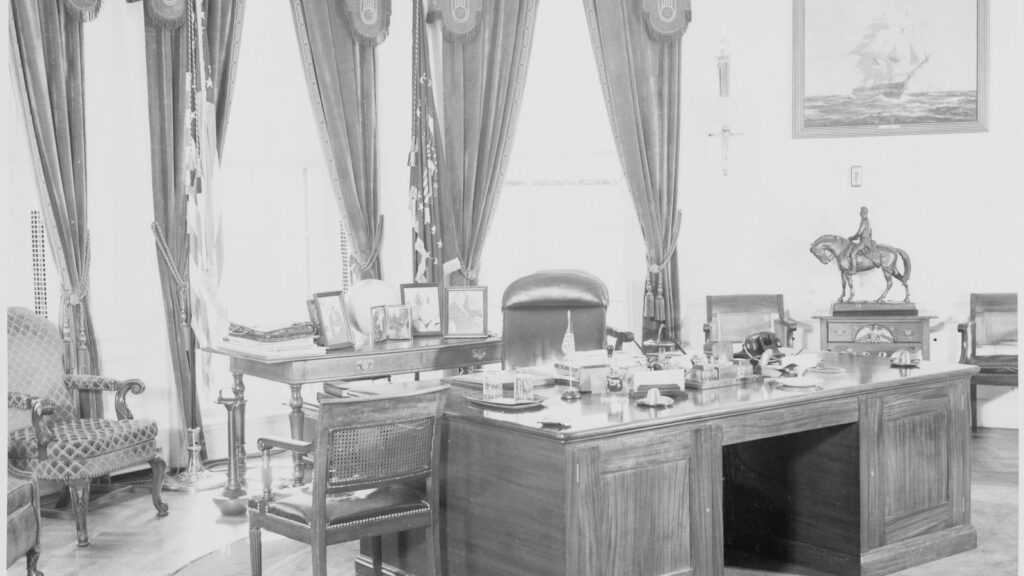
Higher Education for American Democracy is the six-volume 1947 report of the President’s Commission on Higher Education, often called the Truman Commission. It called for doubling college attendance by 1960, tuition-free public education through the first two years of college and an end to racial and religious discrimination in admissions.
Higher Education Resource Hub, higher-ed.org. Last reviewed November 2026. Sources are listed at the end of this page.
Citation and publication
| Title | Higher Education for American Democracy: A Report of the President’s Commission on Higher Education |
|---|---|
| Commission created | 13 July 1946, by President Harry S. Truman |
| Chairman | George F. Zook, President, American Council on Education |
| Appointees | 30, per the Truman Library note on the appointment letter |
| Volume I | Establishing the Goals, dated 11 December 1947, 103 pages, Government Printing Office |
| Volumes II to VI | Released December 1947 through early 1948 |
The publication details come from the Truman Library’s record of the President’s 15 December 1947 statement. The six volume titles are Establishing the Goals, Equalizing and Expanding Individual Opportunity, Organizing Higher Education, Staffing Higher Education, Financing Higher Education and Resource Data, per the full six-volume scan at the Internet Archive.
The report was advisory. It set goals for the nation but had no force of law.
What did the Truman Commission recommend?
The Commission argued that far more Americans could benefit from college than were enrolled. Volume I says, “At least 49 percent of our population has the mental ability to complete 14 years of schooling.”
- Advanced study: The report put the share able to complete an advanced liberal or specialized professional education at 32 percent or more.
- Enrollment target: It set a minimum of 4,600,000 young people enrolled in nonprofit institutions by 1960.
- Free first two years: It called for tuition-free education in public institutions for the freshman and sophomore years, or the traditional two-year junior college course.
- Community colleges: It said the name did not matter, though “community college” seemed to describe these local two-year schools best.
- Student aid: It recommended lowering tuition at public colleges and starting a program of scholarships and fellowships.
- Discrimination: It said the quota system could not be justified on any grounds compatible with democratic principles.
These figures and recommendations come from Volume I as printed by the Government Printing Office, pages 35 to 41, in the HathiTrust scan hosted by George Mason University.
The 49 and 32 percent figures are the Commission’s 1947 estimates of ability, not measured enrollment rates.
How did President Truman present the report?
Truman released Volume I with a short statement on 15 December 1947. He said he looked forward to studying the report and hoped citizens would “examine it carefully,” per the Truman Library.
- The charge: Truman’s 13 July 1946 appointment letter asked the Commission to examine the functions of higher education in American democracy and the best means to perform them.
- The summary: The Truman Library note lists the main recommendations as a curriculum suited to democracy, doubled attendance by 1960, an end to racial and religious discrimination, more federal support and free public education through two years of college.
The statement endorsed study of the report. It did not commit the administration to every recommendation.
Why does the report matter?
The report set a national goal for mass college access. It treated college as within reach of about half of young Americans, not a privilege for a few.
- Access as policy: It came three years after the GI Bill of 1944, whose education title paid veterans’ college tuition.
- Two-year colleges: Its call for tuition-free community colleges framed the two-year sector’s public role.
- Later federal aid: Broad federal student aid came later, with the Higher Education Act of 1965.
The report did not create any program itself. Its effect came through the states, colleges and later Congresses that took up its goals.
For earlier statements on the purpose of college, see the Yale Report of 1828 and Dartmouth College v. Woodward. More founding documents are listed in the history of American higher education.
Frequently asked questions
Who chaired the Truman Commission?
George F. Zook, President of the American Council on Education.
How many volumes is the Truman Commission report?
Six. Volume I, Establishing the Goals, is dated 11 December 1947, and the rest were released through early 1948.
What enrollment goal did the Truman Commission set?
At least 4,600,000 young people enrolled in nonprofit colleges and universities by 1960.
Sources
- Letter Appointing Members to the National Commission on Higher Education, 13 July 1946. Harry S. Truman Library and Museum.
- Statement by the President Making Public a Report of the Commission on Higher Education, 15 December 1947. Harry S. Truman Library and Museum.
- Higher Education for American Democracy, Volume I, Establishing the Goals. U.S. Government Printing Office, 1947. HathiTrust scan hosted by George Mason University.
- Higher Education for American Democracy, Volumes I to VI. Internet Archive.
Sources
- Truman Library’s record of the President’s 15 December 1947 statementtrumanlibrary.gov
- full six-volume scan at the Internet Archivearchive.org
- HathiTrust scan hosted by George Mason Universityhigheredhistory.gmu.edu
Corrections are welcome via the contact page.
Next entryJohn Henry Newman: The Idea of a University (1854)→